
Use this Bottleneck Calculator to check CPU and GPU bottleneck percentage instantly. Find performance issues, avoid hardware mismatches, and build a perfectly balanced gaming PC. Trusted by PC gamers and builders worldwide.
🖥️ PC Bottleneck Calculator
Advanced PC Performance Analyzer – Check Your System Balance
💡 Recommendations
- Select components to see recommendations
You’re in the right place if you’ve ever felt like anything was “holding back the whole system” when you were playing a game or working on a task. This bottleneck calculator was created for actual people who just want to know if their GPU is being slowed down by their CPU or the other way around. No walls of jargon. No speculation. You can only utilize clarity. If you are a Hindi user and want to convert your Unicode into Krutidev, you can use unicode to krutidev easily.
A Brief Greeting to Everyone Who Has Ever Questioned, “Where’s My FPS Going?”
The majority of users come here to construct a new rig, upgrade a GPU, replace a processor, or try to get a bit more performance out of an older setup. The difficulty?
Every forum has a distinct viewpoint, from lengthy MSI support discussions to the “bottleneck calculator reddit” debates.
Therefore, the purpose of this homepage is to supply you with something that those locations seldom offer: a straightforward, reliable bottleneck calculator that you can actually understand at a glance.
Why PC Bottlenecks Even Matter
When the capabilities of your CPU and GPU are not equal, one of them has to wait for the other. The bottleneck is that waiting. Although it’s not always dangerous, it determines:
It’s something every gamer, editor, streamer, and laptop user has to face sooner or later.
What Is a Bottleneck in a PC?
Assume that your GPU is capable of producing 200 frames per second.
However, your CPU’s processing speed is limited to 120.
Alternatively, your outdated graphics card is unable to keep up with your powerful processor.
Both circumstances lead to a mismatch. The PC bottleneck is that mismatch.
Certain games, like CS2 and Fortnite, rely significantly on the CPU. Others require GPU power. Pairing is important, which is why this calculator was created.
How This Bottleneck Calculator Helps You Instantly
You choose your CPU and GPU.
We compare their real-world behavior, not just specs on paper.
Within seconds, you’ll see:
- estimated bottleneck percentage
- whether the CPU or GPU is slowing you down
- where the mismatch happens (gaming, rendering, multitasking)
- simple upgrade guidance
- how the pairing stacks up against modern standards
The entire point is to give you clarity without making you decode charts for hours.
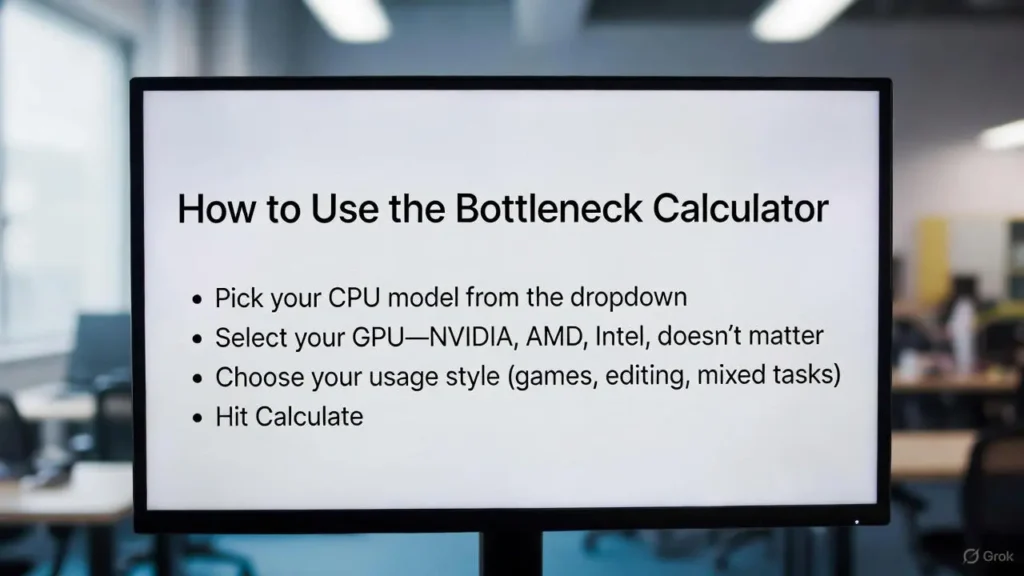
How to Use the Bottleneck Calculator
- Pick your CPU model from the dropdown.
- Select your GPU—NVIDIA, AMD, Intel, doesn’t matter.
- Choose your usage style (games, editing, mixed tasks).
- Hit Calculate.
- Read your bottleneck score with confidence.
If you’re on a laptop, it works just as smoothly. In fact, many visitors use this as their go-to bottleneck calculator laptop tool before buying a new notebook.
When You Should Actually Worry About Bottlenecks
A bottleneck isn’t always bad. In many rigs, a little imbalance is normal.
But the calculator will tell you when it’s severe enough to affect:
If your current setup is holding back your hardware, you’ll know right away.
What Is the True Distinction Between CPU and GPU Bottlenecks?
When the CPU is the Slow One
- FPS doesn’t improve even when lowering resolution
- stuttering in crowded areas of games
- slow rendering in CPU-heavy software
- lower performance in esports titles (Fortnite, CS2, Warzone)
When the GPU Can’t Keep Up
- high CPU usage but weak FPS
- fans ramp up constantly
- GPU maxes out at 99% while CPU sits relaxed
- lowering graphics settings increases FPS a lot
This page translates those signs into simple numbers so you don’t have to guess.
A Look Inside the Logic (Why This Calculator is Trusted)
This isn’t one of the antiquated bottleneck tools from years past or the disorganized, contentious “bottleneck calculator userbenchmark” discussions.
This instrument combines:
It’s the kind of analysis seasoned builders do manually. Now automated for you.
Ideal CPU and GPU Pairings for Modern Builds
You’ll see exact suggestions based on your input, but here’s a taste of how we approach pairing logic:

Additional Information for Gamers Seeking the Smoothest Outcomes
The calculator will indicate where performance loss typically occurs if you intend to play Fortnite, Warzone, Apex, Valorant, CS2, or similar games.
Compared to AAA movies, these games typically expose bottlenecks more forcefully.
We therefore adjusted the reasoning to account for competitive gamers.
Your PC’s Motherboard Matters More Than People Think
Many users overlook this, so it’s baked into our recommendations.
A low-end bottleneck calculator motherboard pairing can create:
- PCIe bandwidth choking
- lower RAM frequency caps
- poor VRM power delivery
- throttling under heavy loads
- unstable boost clocks
Why Laptop Users Love This Tool
Laptop GPUs and CPUs rarely match their desktop counterparts.
Thermal limits make bottlenecks even more unpredictable.
So the calculator accounts for:
- thermal design limits
- mobile CPU behavior
- GPU wattage differences
- turbo frequency dips
- cooling capacity variations
This “bottleneck calculator laptop” feature helps you avoid selecting the incorrect model while inspecting laptops before making a purchase.
A Brief Guide for Upgraders Who Want to Save Money
If your bottleneck percentage comes out high, don’t panic.
You might not need a full rebuild.
Often, a simple change—faster RAM, swapping a cooler, updating your BIOS, or moving to a better motherboard—can restore balance.
The calculator includes upgrade reasoning based on what real builders usually do, not what automated scripts tell you.
Why This Page Uses a Fresh, Human Approach
There are dozens of bottleneck tools floating across the internet, from old forum calculators to generic apps.
Most of them are either inaccurate, outdated, or built around old CPU/GPU generations.
This one is different because it focuses on:
- real-world gaming behavior
- current architectures
- thermal constraints
- resolution-based performance
- future-proof pairing logic
- high refresh monitor support
- modern engines like Unreal 5, Source 2, etc.
You get advice that makes sense in 2025, not 2017.
Who This Calculator Helps the Most
Using This Tool Saves You From Common Pitfalls
A few examples:
- pairing a high-end GPU with an older i5
- wasting money on an overpowered CPU the GPU can’t benefit from
- choosing the wrong MSI laptop variant
- expecting desktop-like performance from mobile GPUs
- underestimating how CPU-bound esports games are
- thinking a motherboard doesn’t matter
- misreading synthetic benchmarks
- relying on outdated Reddit threads
FAQs
Why does my PC feel slower even when the parts are good?
Occasionally, one element is just exerting more effort than the others. The GPU could not be powerful enough for the resolution you’re playing at, or your CPU might be feeding it too slowly. Typically, you’ll notice stutters, erratic frame rates, or your system “pausing” during high-stress situations. Usually, a brief bottleneck check identifies the culprit.
Can upgrading just one part fix a bottleneck?
Yes, in a lot of situations. A faster SSD, additional RAM, a new GPU, or even a CPU switch can relieve the strain. However, what is limiting the system will determine the optimal update. Because you don’t want to spend money on the wrong part, it’s important to check the bottleneck first.
Is a small bottleneck something I should worry about?
Not at all. Almost all PCs have light mismatches. Your hardware and performance won’t be harmed by a little imbalance. Bottlenecks only become significant when you notice a slowdown or when the frame rate refuses to increase despite decreasing the settings.
How do I realistically confirm a bottleneck during gaming?
Keep an eye on your utilization figures. The GPU is maxed out if it is operating at 100% while your CPU is operating well below that. The CPU is your choke point if it is experiencing significant demand while the GPU is underutilized. It’s simple using performance monitoring tools or a quick assessment with a bottleneck calculator.
Do laptops bottleneck more than desktops?
Yes, many do. Mobile GPUs frequently have lower wattage, and laptop CPUs typically operate slower and colder. When combined, that leads to more obvious bottlenecks in demanding games. Before purchasing a gaming laptop, many people do a bottleneck check for this reason.
Is a GPU bottleneck 100% bad?
No. Your GPU is simply being fully utilized if it is the limiting component. In game, that’s frequently ideal. Only when the FPS or smoothness falls below what you require does it become “poor.”
Is a 20 percent bottleneck bad?
Twenty percent is where you might start noticing dips or stutters, especially in fast-paced games. It’s not harmful, but it is noticeable.
Is a 5% CPU bottleneck bad?
Not at all. A 5% bottleneck is extremely normal and won’t affect your experience.
How do I know if I bottleneck?
Look for signs: one component maxing out, FPS not rising even after lowering settings, or uneven frame pacing. Tools and monitoring apps make it easy to confirm.
Can a 3060 Ti run 240Hz?
Yes—in the right games. Esports titles like CS2 or Valorant can hit 240 FPS. Heavy AAA games usually can’t.
What if the GPU is at 100%?
Totally normal. Many GPUs spend most of their time at 100% during games. Just keep an eye on temperatures.
Is 98% GPU usage normal?
Yes. Many games push the GPU hard. Anything from 95–100% is perfectly normal.
Final Word
Your PC is a personal machine. You deserve to know where it shines and where it struggles.
This homepage exists to help you make smarter decisions—without any confusing tech-speak or vague predictions.
Whether you’re:
- building from scratch,
- planning a GPU upgrade,
- considering a CPU swap,
- comparing MSI laptops, or
- simply curious what your current system is capable of…
…the Bottleneck Calculator gives you a clear, fast, accurate picture every single time.
Go ahead—run your first check.
Your next upgrade will feel a lot easier after you see the real numbers